Publications
Selected publications / preprints.
2026
- TokDrift: When LLM Speaks in Subwords but Code Speaks in GrammarYinxi Li, Yuntian Deng, and Pengyu NieIn Proceedings of the 64th Annual Meeting of the Association for Computational Linguistics (Volume 1: Long Papers), Jul 2026
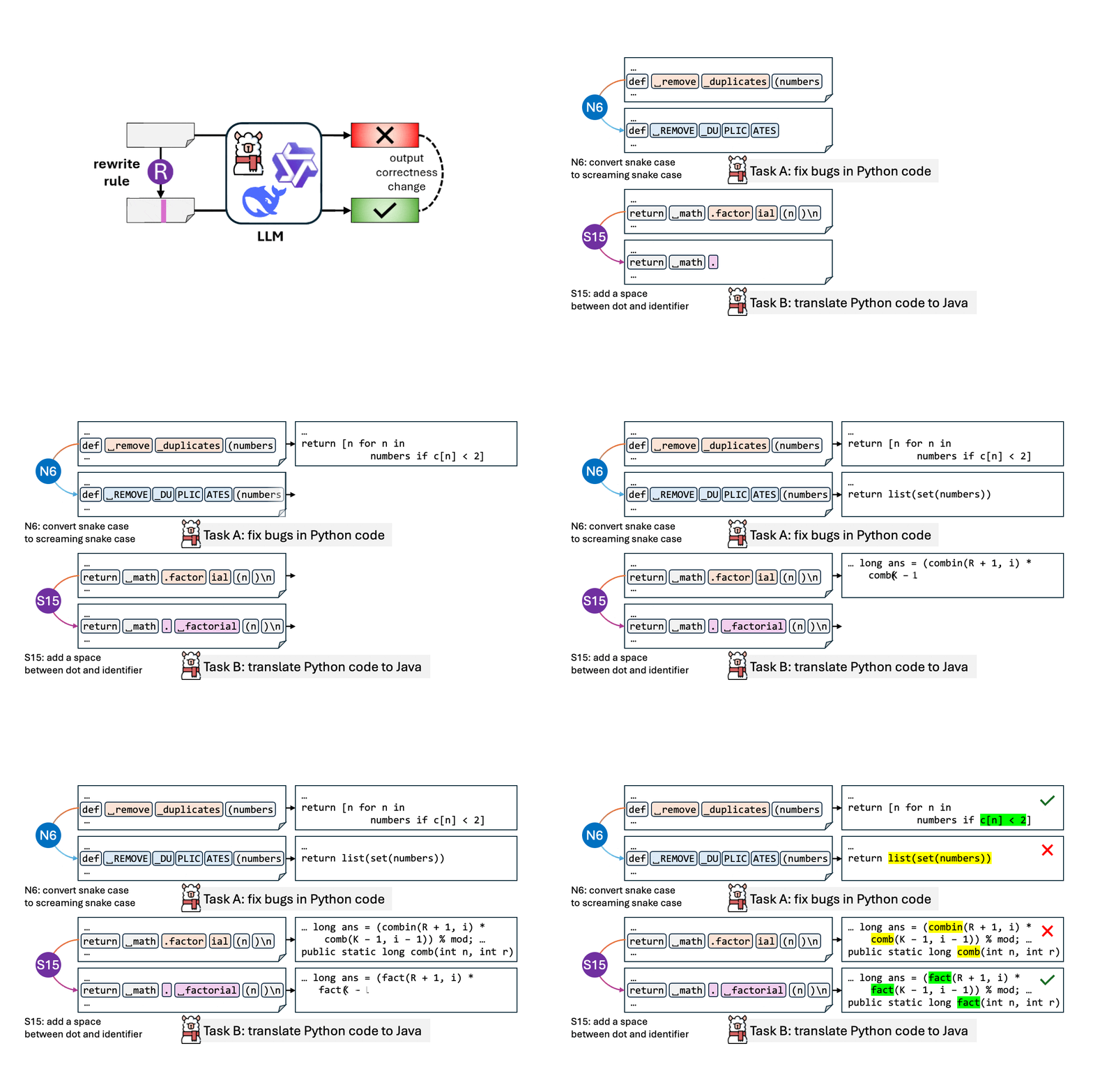
Large language models (LLMs) for code rely on subword tokenizers, such as byte-pair encoding (BPE), learned from mixed natural language text and programming language code but driven by statistics rather than grammar. As a result, semantically identical code snippets can be tokenized differently depending on superficial factors such as whitespace or identifier naming. To measure the impact of this misalignment, we introduce TokDrift, a framework that applies semantic-preserving rewrite rules to create code variants differing only in tokenization. Across nine code LLMs, including large ones with over 30B parameters, even minor formatting changes can cause substantial shifts in model behavior. Layer-wise analysis shows that the issue originates in early embeddings, where subword segmentation fails to capture grammar token boundaries. Our findings identify misaligned tokenization as a hidden obstacle to reliable code understanding and generation, highlighting the need for grammar-aware tokenization for future code LLMs.
@inproceedings{li-etal-2026-tokdrift, title = {{T}ok{D}rift: When {LLM} Speaks in Subwords but Code Speaks in Grammar}, author = {Li, Yinxi and Deng, Yuntian and Nie, Pengyu}, editor = {Liakata, Maria and Moreira, Viviane P. and Zhang, Jiajun and Jurgens, David}, booktitle = {Proceedings of the 64th Annual Meeting of the {A}ssociation for {C}omputational {L}inguistics (Volume 1: Long Papers)}, month = jul, year = {2026}, address = {San Diego, California, United States}, publisher = {Association for Computational Linguistics}, url = {https://aclanthology.org/2026.acl-long.2199/}, doi = {10.18653/v1/2026.acl-long.2199}, pages = {47605--47629}, isbn = {979-8-89176-390-6}, } - PreprintOSWorld-Science: A Benchmark of Computer Use Agents for Learning and Using Scientific SoftwareDingyuan Dai*, Heli Qi*, Lei Liu*, Yinxi Li*, Baiding Chen*, Zijun Dou*, and 25 more authorsSep 2026* Equal contribution
Scientific software presents a demanding test for computer-using agents based on visual language models (VLMs): completing a research workflow requires interpreting specialized interfaces, manipulating scientific objects, and producing verifiable results. We thus introduce OSWorld-Science, a benchmark and evaluation environment that combines scientifically meaningful tasks, artifact-based evaluation, and an efficient agent harness for studying computer use in the scientific domain. The benchmark contains 12 VLMs and 146 high-quality tasks across several scientific domains and software configurations, covering workflows such as molecular drawing and retrosynthesis, pathology image analysis, statistical computing, and physical simulation. Tasks are developed through expert proposals and iterative human–AI co-design, with selection guided by scientific value and difficulty. Task-specific execution-based evaluators inspect application states and generated artifacts, including molecular structures, segmentation masks, plots, and numerical results, and award partial credit for incomplete outcomes. Our special harness integrates model adapters, interaction-loop control, and trajectory logging to support comparisons of models and interaction strategies. Our results show that current state-of-the-art VLMs with a strong harness still face challenges in addressing key questions in the scientific domains. We also analyze the benchmarking results across multi-linguistics, reasoning efforts, context length and other factors and derive several important conclusions and directions to assist future development. Overall, we provide an integrated framework connecting expert-defined scientific goals to verifiable software outcomes, enabling systematic evaluation of both agent capabilities and harness design in scientific workflows.
@misc{dai2026osworldscience, title = {{OSWorld-Science}: A Benchmark of Computer Use Agents for Learning and Using Scientific Software}, author = {Dai, Dingyuan and Qi, Heli and Liu, Lei and Li, Yinxi and Chen, Baiding and Dou, Zijun and Zeng, Qingcheng and Kang, Qi and Sun, Oliver and Wang, Eric and Zhou, Bo and Wang, Haixin and Du, Yufan and Bo, Shi and Lin, Ruihan and Yuan, Mengqi and Lu, Dunjie and Dillmann, Steven and Shi, Yiming and Su, Tina and Xin, Amy and Liu, Minghao and Wang, Xi and Huang, Xu and Zhang, Ge and Nie, Pengyu and Yang, Zhen and Tang, Jie and Li, Juanzi and Xuan, Weihao and Liu, Tianyu}, year = {2026}, month = sep, eprint = {2609.39903}, archiveprefix = {arXiv}, url = {https://arxiv.org/abs/2609.39903}, note = {* Equal contribution}, } - Learning Multi-step Reasoning via Persistent Latent State PropagationYinxi Li, Jiaao Chen, Fang Wu, Jiakai Yu, Heli Qi, Weihao Xuan, and 4 more authorsIn ICLR 2026 Workshop on Latent & Implicit Thinking – Going Beyond CoT Reasoning, Apr 2026
@inproceedings{li2026learning, title = {Learning Multi-step Reasoning via Persistent Latent State Propagation}, author = {Li, Yinxi and Chen, Jiaao and Wu, Fang and Yu, Jiakai and Qi, Heli and Xuan, Weihao and Zhao, Haokai and Nie, Pengyu and Jin, Di and Tang, Xiangru}, booktitle = {ICLR 2026 Workshop on Latent {\&} Implicit Thinking {\textendash} Going Beyond CoT Reasoning}, year = {2026}, month = apr, url = {https://openreview.net/forum?id=Dcv4B1UCuW}, } - PreprintCode2LoRA: Hypernetwork-Generated Adapters for Code Language Models under Software EvolutionLiliana Hotsko, Yinxi Li, Yuntian Deng, and Pengyu NieJun 2026
Code language models need repository-level context to resolve imports, APIs, and project conventions. Existing methods inject this knowledge as long inputs (retrieved through RAG or dependency analysis) or through per-repository fine-tuning and LoRA – costly at repository scale and brittle to evolving codebases. We introduce Code2LoRA, a hypernetwork framework that generates repository-specific LoRA adapters, effectively injecting repository knowledge with zero inference-time token overhead. Code2LoRA supports two usage scenarios: Code2LoRA-Static converts a single repository snapshot into an adapter, suitable for comprehension of stable codebases; while Code2LoRA-Evo maintains an adapter backed by a GRU hidden state updated per code diff, suitable for active development of evolving codebases. To evaluate Code2LoRA against parameter-efficient fine-tuning baselines, we build RepoPeftBench, a benchmark of 604 Python repositories with two tracks: a static track with 40K training and 12K test assertion-completion tasks, and an evolution track with 215K commit-derived training and 87K commit-derived test tasks. On the static track, Code2LoRA-Static achieves 63.8% cross-repo and 66.2% in-repo exact match, matching the per-repository LoRA upper bound; on the evolution track, Code2LoRA-Evo achieves 60.3% cross-repo exact match (+5.2 pp over a single shared LoRA). Code2LoRA’s code can be found at https://anonymous.4open.science/r/code2lora-6857; the model checkpoints and RepoPeftBench datasets can be found at https://huggingface.co/code2lora.
@misc{hotsko2026code2lorahypernetworkgeneratedadapterscode, title = {Code2LoRA: Hypernetwork-Generated Adapters for Code Language Models under Software Evolution}, author = {Hotsko, Liliana and Li, Yinxi and Deng, Yuntian and Nie, Pengyu}, year = {2026}, month = jun, eprint = {2606.06492}, archiveprefix = {arXiv}, primaryclass = {cs.SE}, url = {https://arxiv.org/abs/2606.06492}, } - Survey
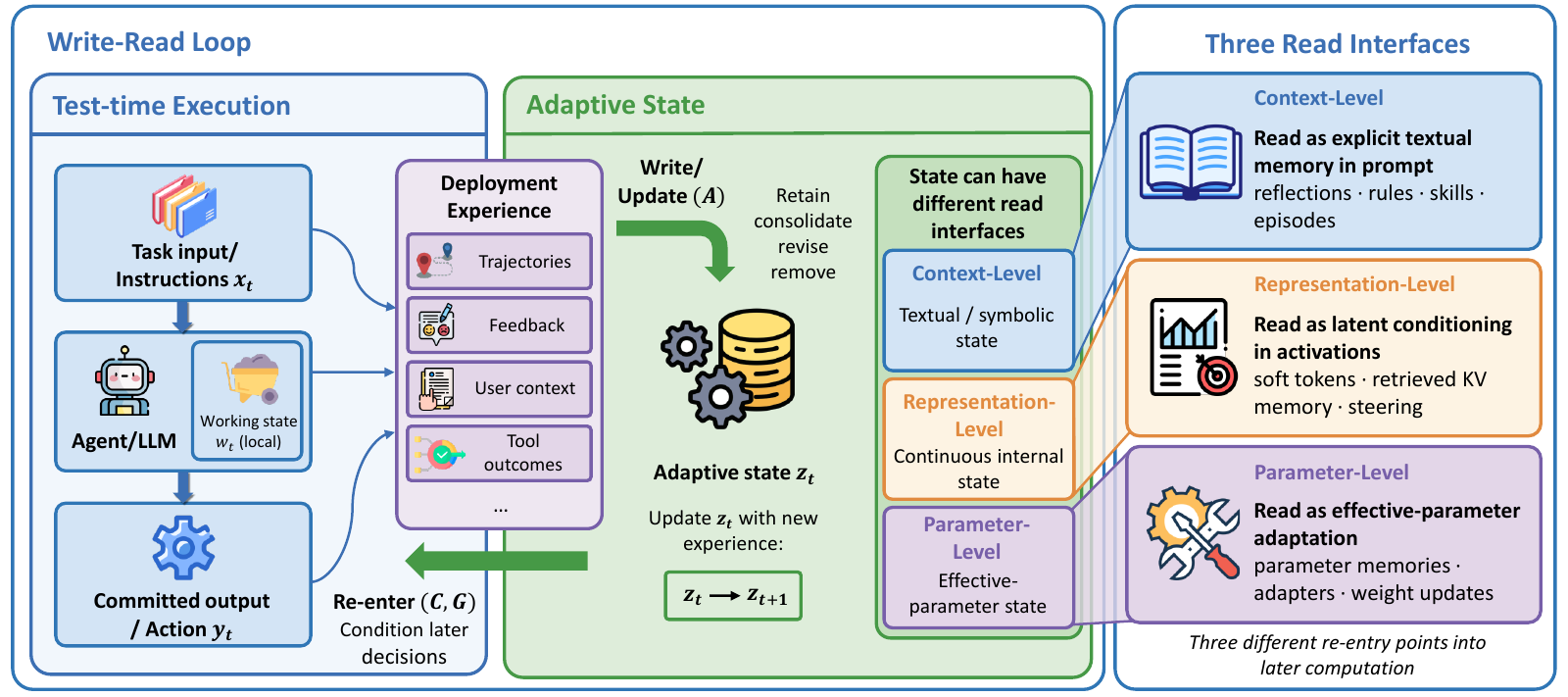 Learning from Use: Test-Time Learning in Large Language Models and AgentsWeihao Xuan*, Qingcheng Zeng*, Jiarui Liu*, Rui Yang*, Yunze Xiao, Yinxi Li, and 25 more authorsAug 2026* Equal contribution; SSRN working paper No. 7319678
@misc{xuan2026learning, author = {Xuan, Weihao and Zeng, Qingcheng and Liu, Jiarui and Yang, Rui and Xiao, Yunze and Li, Yinxi and Zhou, Zeqi and Sun, Weiwei and Qi, Heli and Cui, Leyang and Ma, Tianhao and Cao, Hanqun and Wang, Junjue and Liu, Tianyu and Du, Weihua and Song, Yueqi and Geng, Jiayi and Wong, Matthew Yu Heng and Voigt, Rob and Hong, Chuan and Yue, Xiang and Huang, Jen-tse and Xu, Xuhai and Peng, Yifan and Heng, Pheng-Ann and Yang, Yiming and Sch{\"o}lkopf, Bernhard and Jin, Zhijing and Liu, Nan and Yokoya, Naoto and Diab, Mona}, title = {Learning from Use: {Test-Time Learning} in {Large Language Models} and Agents}, year = {2026}, month = aug, howpublished = {SSRN}, note = {* Equal contribution; SSRN working paper No. 7319678}, url = {https://papers.ssrn.com/sol3/papers.cfm?abstract_id=7319678}, } - Proteo-R1: Reasoning Foundation Models for De Novo Protein DesignFang Wu*, Weihao Xuan*, Heli Qi*, Hanqun Cao*, Heng-Jui Chang*, Zeqi Zhou*, and 23 more authorsIn Forty-third International Conference on Machine Learning, Jul 2026* Equal contribution
Deep learning in de novo protein design has achieved atomic-level fidelity. However, existing models remain largely non-deliberative: they directly synthesize molecular geometries without explicitly reasoning about which residues or interactions are functionally essential. As a result, design decisions are entangled with continuous sampling dynamics, limiting interpretability, controllability, and systematic reuse of biochemical knowledge. We introduce Proteo-R1, a reasoning-guided protein design framework that explicitly decouples molecular understanding from geometric generation. Proteo-R1 adopts a dual-expert architecture in which a multimodal large language model (MLLM) serves as an understanding expert, analyzing protein sequences, structures, and textual context to identify key functional residues that govern binding and specificity. These residue-level decisions are then passed as hard constraints to a separate diffusion-based generation expert, which performs conditional co-design while respecting the fixed interaction anchors. This factorization mirrors how human experts approach molecular engineering: first, reasoning about critical interactions, then optimizing geometry subject to those constraints. By operationalizing reasoning as explicit residue-level commitments rather than latent textual guidance, Proteo-R1 achieves stable, interpretable, and modular integration of LLM reasoning with state-of-the-art geometric generative models. Code, data, and demos are available at https://smiles724.github.io/r1/.
@inproceedings{wu2026proteor, title = {Proteo-R1: Reasoning Foundation Models for De Novo Protein Design}, author = {Wu, Fang and Xuan, Weihao and Qi, Heli and Cao, Hanqun and Chang, Heng-Jui and Zhou, Zeqi and Li, Li Erran and Zhao, Haokai and Ma, Jian and Ma, Zijian Carl and Cheng, Yu-Chi and Pang, Kuan and Tang, Xiangru and Wang, Zehong and Li, Guanlue and Wang, Hanchen and Ying, Kejun and Lu, Pan and Im, Chiho and Han, Seungju and Xia, Peng and Xu, Tinson and Li, Yinxi and Zhu, Deyao and Heng, Pheng-Ann and Yokoya, Naoto and Sugiyama, Masashi and Leskovec, Jure and Choi, Yejin}, booktitle = {Forty-third International Conference on Machine Learning}, year = {2026}, month = jul, url = {https://openreview.net/forum?id=dDowWwInhz}, note = {* Equal contribution}, } - Preprint
 Position: The Hidden Costs and Measurement Gaps of Reinforcement Learning with Verifiable RewardsFang Wu*, Aaron Tu*, Weihao Xuan*, Heli Qi*, Xu Huang, Qingcheng Zeng, and 18 more authors2026
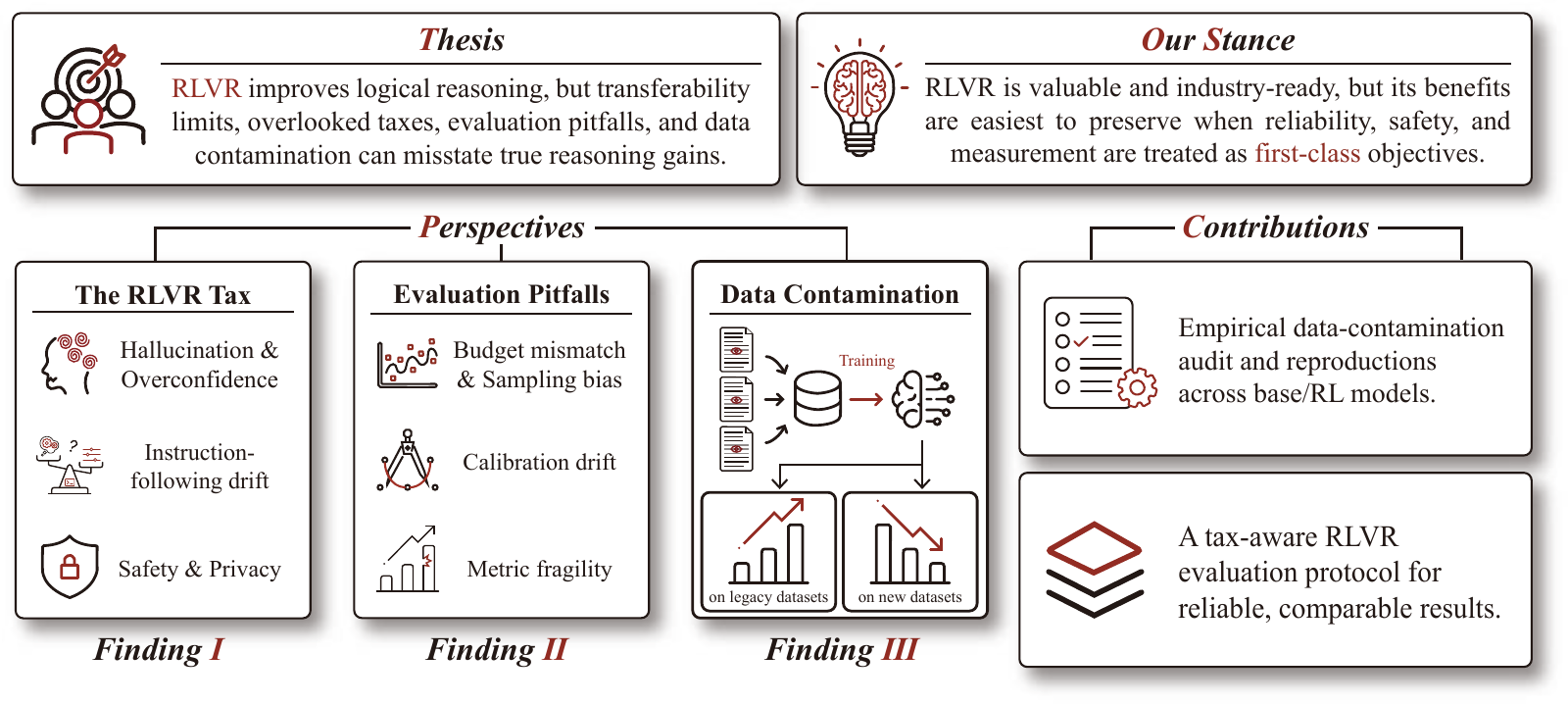
Reinforcement learning with verifiable rewards (RLVR) is a practical, scalable way to improve large language models on math, code, and other structured tasks. However, we argue that many headline RLVR gains are not yet well validated because reports often conflate policy improvement with three confounds: (i) budget mismatch between RLVR and baseline evaluations, (ii) attempt inflation and calibration drift that convert abstentions into confident answers, and (iii) benchmark data contamination. Using budget-matched reproductions and partial-prompt contamination probes, we find that several widely cited gaps shrink substantially or disappear once budgets, prompts, and dataset versions are matched and contaminated sets are treated as memorization probes rather than evidence of reasoning. This does not mean that RLVR is ineffective, but it implies that current measurements often overstate capability gains and obscure reliability costs. We therefore propose a compact, tax-aware minimum standard for RLVR training and evaluation: budget-matched saturation curves with variance, calibration, and abstention tracking, a judge-robustness stress test when LLM judges are used, and an explicit contamination screen. With these controls, RLVR remains effective and deployable in verifiable domains, but reasoning gains should be treated as provisional without them.
@misc{wu2026positionhiddencostsmeasurement, title = {Position: The Hidden Costs and Measurement Gaps of Reinforcement Learning with Verifiable Rewards}, author = {Wu, Fang and Tu, Aaron and Xuan, Weihao and Qi, Heli and Huang, Xu and Zeng, Qingcheng and Talaei, Shayan and Xiao, Yijia and Xia, Peng and Tang, Xiangru and Zhuang, Yuchen and Li, Yinxi and Hu, Bing and Cao, Hanqun and Shi, Wenqi and Yang, Rui and Liu, Nan and Yao, Huaxiu and Liu, Ge and Li, Li Erran and Saberi, Amin and Yokoya, Naoto and Leskovec, Jure and Choi, Yejin}, year = {2026}, eprint = {2509.21882}, archiveprefix = {arXiv}, primaryclass = {cs.LG}, url = {https://arxiv.org/abs/2509.21882}, } - PreprintNoiseRater: Meta-Learned Noise Valuation for Diffusion Model TrainingFang Wu*, Haokai Zhao*, Da Xing, Hanqun Cao, Tinson Xu, Yanchao Li, and 14 more authorsMay 2026
Training a diffusion model involves two sources of randomness for each data sample: the timestep and the Gaussian noise realization. The timestep has been studied extensively through scheduling and weighting, whereas the impact of the noise realization at a given timestep is still underexplored. In this work, we examine whether different noise instances are equally informative. We introduce NoiseRater, a network that scores an individual noise instance conditioned on the data sample and timestep. The rater is learned through bilevel optimization, where its scores reweight the diffusion loss in the inner loop, and it is updated to reduce validation loss after the inner-loop updates. Using the trained rater to select training noise, we observe three properties of training noise. First, noise realizations at the same timestep are not equally useful: the rater’s top-scored noise improves performance over i.i.d. sampling, while its bottom-scored noise degrades it. Second, this utility is contextual, depending jointly on the image, the class, and the timestep. Third, noise selection is complementary to timestep-level design, retaining most of its gain when combined with existing scheduling and weighting schemes. These findings establish instance-level noise valuation as a new axis for understanding and improving diffusion training. Code is available at https://github.com/JoeZhao527/Noise-Rater.
@misc{wu2026noiseratermetalearnednoisevaluation,
  title = {NoiseRater: Meta-Learned Noise Valuation for Diffusion Model Training},
  author = {Wu, Fang and Zhao, Haokai and Xing, Da and Cao, Hanqun and Xu, Tinson and Li, Yanchao and Tang, Xiangru and Wang, Zehong and Tu, Aaron and Pang, Kuan and Wang, Hanchen and Lin, Hongbin and Zhou, Zeqi and Li, Yinxi and Xia, Peng and Li, Li Erran and Tao, Molei and Leskovec, Jure and Joshi, Aditya and Choi, Yejin},
  year = {2026},
  month = may,
  eprint = {2605.08144},
  archiveprefix = {arXiv},
  primaryclass = {cs.LG},
  url = {https://arxiv.org/abs/2605.08144},
}